Introduction to the initiative
It has been witnessed among students and young entrepreneurs that they lack a certain
set of knowledge-based skills which are essential for a successful entrepreneur.
The lack of students’ (candidates’) readiness can be referred to two main reasons;
firstly, is because the theories taught in business schools with regards to entrepreneurship
are not context dependent. In other words, most of the theories offered do not address
the distinctiveness of the Saudi market. Secondly, the absence of the mechanisms
with which ideas (in the minds of the entrepreneurs) can be transformed to a feasible
business model (commercialization of ideas). However, it needs to be recognized
that candidates with business degrees are much more prepared to go through such
journey than candidates with none business degrees especially engineers.
The vision
Is to contribute to the development and advancement of entrepreneurship in the Saudi
market in a way that positively impacts commerce in Saudi Arabia and nearby economies.
The mission
Is to establish a multi-functional center where students and interested candidates
can gain the type of knowledge-based skills to become successful entrepreneurs.
The center should be designed to provide a range of advice and education for individuals
and to other organizations, such as; SMEs in local and regional community. In this
way, individuals are developed to start their own businesses and advice and support
can be provided to existing organizations as well.
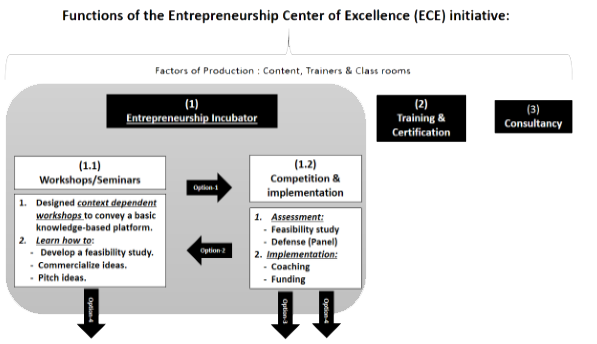
The main function of the entrepreneurship center of excellence (ECE):
As illustrated in the figure above, the center will contain three main functions
which will enable achieving the center’s vision and they will be explained as follows:
-
The Entrepreneurship incubator
The objective of this function is to develop and offer a mechanism with which candidates
will be able to commercialize their idea (i.e. transform ideas to feasible and scalable
businesses) and it contains two main sub-functions; entrepreneurship workshops/seminars
series and entrepreneurship competition. These will be explained separately below:
-
Entrepreneurship workshops/seminars
The initial objective of this function is to deliver a set of seminars aimed to
educate interested candidates and help develop and strong platform of entrepreneurial
knowledge. These seminars are not specific to subjects but also customized to accommodate
the distinctiveness of the Saudi Market. The overall outcome of these seminars is
to enable interested candidates to learn develop a professional feasibility study
and prepare them for the implementation stage of their new venture. It is of paramount
importance to ensure that candidates understand the uniqueness and distinctiveness
of the Saudi market to order to improve their chances of success. For this reason,
such seminars should be built on existing generic (theoretical) knowledge yet address
the applicability of such knowledge in the Saudi market. To do achieve that, instructors/speakers
must be more practitioners rather than pure academics (see attachment-1; workshops/seminars
table of content). This function/initiative can also be considered as a “feeder”
to the competition (1.2) which will be discussed in the following section. Should
applicants to the workshop decide not to compete after completion, they can do so
which is represented by option (4). Alternatively, applicant will also be given
the opportunity to compete (after completing the workshop) which is represented
by option (1). -
Entrepreneurship competition
This function can be considered as a standalone initiative which basically establishing
a platform for young entrepreneurs to compete against the panel of judges. This
initiative is to provide the testing ground for knowledgeable entrepreneurs to pitch
their ideas and the visibility of their new venture. Theoretically, candidates participating
in this initiative are expected to be ready for implementation. This entails that
participating candidates are either candidates who just completed the workshops/seminars
series (following option-1 in function 1.1), or candidates who are already experienced
and ready to compete. Therefore, a screening process should take place to decide
on which new venture proposal will be allowed to compete in the first place. The
screening criteria are summarized in a form that is developed to document and control
the judges’ assessment in each criteria and to ensure consistence in evaluation
(attachment-2; Entrepreneurship competition’s assessment form). In order for the
incubator to add further value, unsuccessful contenders in the competition can apply
to the entrepreneurship workshop/seminar series to improve their business plan which
is represented by option (2).
Applicants are expected to submit their proposals to the director of the entrepreneurship
center of excellence (ECE) according to a preannounced date. The director will form
(chair) the screening (process) and announce the list of candidates to be enrolled
in the competition. A venue will be arranged to conduct the competition within PMU.
Each of the competing proposal is expected to be defend against the panel which
might contains practitioners, successful entrepreneurs and academics. The ultimate
goal of this initiative is not only ensure the feasibility of the venture but also
to prepare those candidates to attract/persuade potential investors. The remaining
part is to mobilize required resources to provide support to the winning proposal
(s).
the nature of support to be offer to the winning proposals include two main parts;
coaching and funding which represent the implementation stage of the new venture.
If owners of the winning proposal (s) are interested to have PMU as a partner, a
suitable coach is will be assigned to provide supervision and guidance to the entrepreneurs.
Also, the assigned coach will assist the owners to develop and submit a proposal
for funding to the director of the ECE who will aim to obtain required approvals
to process and release the funds. The entrepreneurs are not obligated to offer any
equity shares against PMU’s support; which is represented by option (3) in the figure
above. Alternatively, if winning candidates decide not receive coaching and funding
from PMU, they are also allowed to seek support elsewhere which is represented by
option (4).
-
Training and certification
This function is aimed to design and offer more specialized workshops and certifications
related to entrepreneurship as a specialty. For example, offering intensive certifications
(or diploma level) in financial reporting, project management and business law.
This function can be operated by PMU’s faculty members and managed by the deanship
of business development and community service especially when such certifications
are offer to the public. Therefore, this function follows all existing and approved
policies used by the deanship of business development and community service. -
Consultancy
This function is aimed to enhance PMU’s contribution to society by providing consultancy
for existing and newly established ventures/companies. This function as part of
the entrepreneurship center of excellence is aligned with PMU’s strategic goals.
Therefore, this function is also follows all existing and approved policies that
governs PMU’s faculty and staff providing consultation to external bodies.